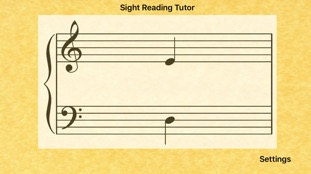
Welcome to Sight Reading Tutor

Sight Reading Tutor is a new app for iOS (iPhone and iPad) designed specifically to speed up your piano music sight reading abilities. It features carefully designed and ordered flashcards, progressing in difficulty, which you can call up by simply tapping on the screen. It is a no-nonsense app, without fancy graphics or animations, which has one goal in mind - to improve your sight reading!
What is “Sight Reading Tutor”?
Who is “Sight Reading Tutor” for?
Sight Reading Tutor is mainly, at the moment, designed for piano players. That doesn’t mean that new versions for other instruments won’t be coming up in the future (and we’d love to hear from other instrumentalists with their ideas), and nor does it mean that players of other instruments can’t use it. But in its conception, Sight Reading Tutor was designed for piano players who wish to improve their sight reading abilities.
Sight Reading Tutor is great for those who wish to be self-taught, or who wish to brush up on their sight reading abilities between lessons. When used in the right way, Sight Reading Tutor will give you vastly improved recognition of notes, phrases, chord shapes and the relationships between notes. The results come fast.
In addition, Sight Reading Tutor is absolutely ideal for teachers. It can give your students some real and immediate understanding of written music... with the system, appearance and purpose of written music becoming readily apparent as the app is used.
The Sight Reading Tutor app can be used for simply calling out note names, or for playing single notes, dyads, chords etc. Or it could be used for recognising intervals (octaves, sevenths, thirds etc), and it can also be used for recognising key signatures and time signatures. You’ll find plenty of suggested workouts on this website.
Who is “Sight Reading Tutor” not for?
Sight Reading Tutor is not aimed at absolute beginners with no knowledge at all of written music. Sight Reading Tutor is designed to speed up your sight reading, even if you are starting from a very low base. It is not designed to teach you the names of notes or where they appear on the staff - it is assumed that you can figure that out from mnemonics (“Every Good Boy Deserves Football”; “All Cows Eat Grass” etc) or from being shown by a teacher. (There are also some basic reference charts downloadable from this website.) However, once you know the note names and where they appear on the staff, fire up Sight Reading Tutor and you are away!
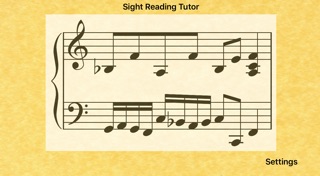
Do I need “Sight Reading Tutor”?
You may well not need it! If you are currently a fluent, skilled and un-fazed reader and player of written music, then you definitely don’t need it! However, if you find the reading of music a tricky business, or even a constant struggle, perhaps even enough to make you want to quit playing, then you’re in the right place. Whatever you do, DON’T quit playing! Sight Reading Tutor will, with regular use, demystify and ease the process of music reading, gradually turning the written music on the page from your enemy... to your friend.
If you’re serious about playing the piano - even if you only play for your own personal enjoyment - then there’s not really any way to avoid learning to read music. You’ll need to do it. Oh, sure... you could always say, “I’ll just play from chord symbols,” or “I’ll just improvise,” or even “Reading music is for squares who can’t really play from the heart.” But these are just irrational excuses, of course, and they simply give flimsy justification to anyone who really doesn’t want to put in the effort of learning how to read music. If you really want to play the piano (or any other musical instrument) then reading music will form a big part of that skill, and there’s no running away from it.
Sight Reading Tutor gives you the method for learning how to read music. But it cannot do the work for you - you have to use the app regularly to get the results you’re looking for, and you’ll find suggested systems and workouts on this website. But Sight Reading Tutor certainly speeds up the process of learning to read music, and the results are well worth having.